

The One Item Missing From Our Back-to-School List
A new backpack, but not full protection
When I was a boy, the end of summer had a smell and a rhythm. My parents would count the weeks until school started again. Then the shopping began. I could not wait to go back. I was fortunate: my parents could afford new shoes, always a little too big so they would last, a fresh notebook, pencils, and a backpack. My parents wanted my brothers, my sister, and me ready for the first day, and they did everything they could to do it right.
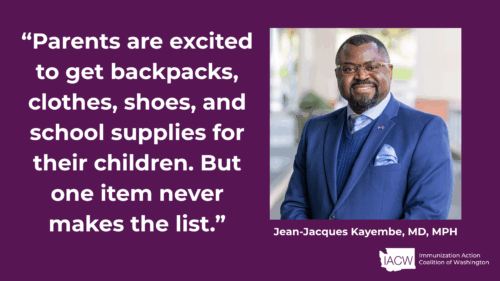
As a parent, a provider, and a community leader, I see the same pattern when the Congolese United Foundation or another community organization holds a late-summer health fair. Parents are excited to get backpacks, clothes, shoes, and school supplies for their children. But one item never makes the list (and no one noticed it when I was a child, not even my parents). Nobody checked whether we were protected against the illnesses that spread every fall and winter when children come back together in one classroom. That missing item was our vaccines.
Why the season matters
Fall and winter are when respiratory illnesses spread the most. Children sit close together indoors, and one cough can reach many. COVID-19, measles, whooping cough, and the flu can send a child to the hospital.
Fewer children in Washington are up to date on their shots. The state Department of Health reports the kindergarten vaccination rate has dropped more than 4% since the 2020–2021 school year.¹ As protection slips, disease returns: Washington reported measles cases in both 2025 and 2026, including small children.¹ ²
A federal order that shifts risk onto our families
In Washington, D.C., on August 10, an executive order narrowed the list of vaccines recommended for all children, moving hepatitis A, hepatitis B, influenza, COVID-19, rotavirus, and meningococcal protection into risk-based or “shared clinical decision-making” categories. The Congolese United Foundation and the Immunization Action Coalition of Washington oppose it.
The order is presented as expanding parental choice. In our community, it will do the opposite. Choice requires clear information and real access. The families most harmed when federal guidance becomes ambiguous are those new to this country, navigating care in a second language, and relying on Medicaid and the Vaccines for Children program. Our parents are not asking for fewer vaccines. They are asking for straight answers and a clinic that will see their child. Calling confusion ‘choice’ does not make it one. Hepatitis B is far more common in Central Africa, and many of our families travel to a region where measles and polio still circulate. This shifts risk onto the children least able to absorb it.
Good news! Washington’s childhood immunization requirements have not changed. With the West Coast Health Alliance and our state’s public health leaders, we urge families to follow the schedule recommended by the American Academy of Pediatrics and bring their questions to a trusted provider.
Vaccines protect more than one child
When you vaccinate your child, you also protect your neighbor’s child. That is herd immunity: when enough people are vaccinated, measles, whooping cough, and influenza spread far less. That shield matters most for those who cannot be vaccinated: infants and children in cancer treatment. Many of our families live in multigenerational homes; I live with my children and my mother-in-law. Protecting a child protects grandparents too.
The smartest investment we can make
For children born between 1994 and 2023, the CDC found routine childhood vaccines saved about $540 billion in direct medical costs and $2.7 trillion in societal costs.³ For every $1 spent, communities save around $11.⁴ A measles outbreak costs public health teams about $244,000 before a single additional case is counted.⁵ A hospital stay is far more expensive, and more painful, than a shot.
The vaccine many parents miss: HPV
One vaccine I especially want African immigrant parents to know about is the Human Papillomavirus (HPV). HPV is common and can cause six kinds of cancer later in life, including cancers of the cervix and throat.⁶ The vaccine works best given early, around ages 9 to 12, years before any chance of exposure.
Does it really prevent cancer? Yes. Among nearly 1.7 million young women, those vaccinated before age 17 had almost a 90 percent lower rate of cervical cancer.⁷ ⁸ Yet only about 63 percent of teens nationally are up to date on HPV, compared with over 90 percent for other adolescent vaccines.⁹ That is a gap we can close, one family at a time.
One more item for your list
As you prepare for the school year (shoes, clothes, notebooks, backpacks), add one more essential item: vaccination. Speak with your child’s doctor, visit a local clinic, or attend one of the health fairs where Public Health – Seattle & King County and the state Department of Health offer free or low-cost vaccines in several languages through September.
If you are not sure where to start, you are not alone. Help Me Grow WA connects families across our state to care. Call 1-800-322-2588 for a family resource navigator (interpretation available) or use resources.helpmegrowwa.org to find a Vaccines for Children provider near you; that program covers eligible children at no cost. Navigators can also help with Apple Health questions, so an insurance gap does not become a missed appointment.
I think about what our parents gave us with the knowledge they had. Today we have more tools and more information. Whatever is decided in Washington, D.C., the decision at your kitchen table is still yours, and still the best protection your child can carry into the classroom. Let us send our children into this school year ready to learn, protected and able to thrive.
Prepared by
Jean-Jacques Kayembe, MD, MPhil, MPH
Founder and Chief Executive Officer, Congolese United Foundation (CUF),
Co-Chair, Immunization Action Coalition of Washington (IACW), Executive Committee
References
- Washington State Department of Health. School Immunization Data. Olympia, WA. Accessed August 2026. https://doh.wa.gov/data-and-statistical-reports/washington-tracking-network-wtn/school-immunization
- International Vaccine Access Center, Johns Hopkins Bloomberg School of Public Health. Status of Childhood Immunization in Washington (2026).
- Zhou F, Jatlaoui TC, Leidner AJ, et al. Health and Economic Benefits of Routine Childhood Immunizations in the Era of the Vaccines for Children Program — United States, 1994–2023. MMWR Morb Mortal Wkly Rep. 2024;73(31):682–685. https://www.cdc.gov/mmwr/volumes/73/wr/mm7331a2.htm
- American Action Forum. Vaccine Protection and Productivity: The Economic Value of Vaccines. 2026. https://www.americanactionforum.org/research/vaccine-protection-and-productivity-the-economic-value-of-vaccines/
- International Vaccine Access Center, Johns Hopkins Bloomberg School of Public Health. Estimating the Financial Costs of Measles Outbreaks. 2025. https://publichealth.jhu.edu/ivac/2025/estimating-the-financial-costs-of-measles-outbreaks
- Centers for Disease Control and Prevention. HPV Vaccine Safety and Effectiveness Data (2024).
- Lei J, Ploner A, Elfström KM, et al. HPV Vaccination and the Risk of Invasive Cervical Cancer. N Engl J Med. 2020;383(14):1340–1348. doi:10.1056/NEJMoa1917338
- Kjaer S.K. et al. Real-World Effectiveness of Human Papillomavirus Vaccination Against Cervical Cancer. JNCI, 2021.
- Pingali C, Yankey D, Elam-Evans LD, et al. Vaccination Coverage Among Adolescents Aged 13–17 Years — National Immunization Survey-Teen, United States, 2024. MMWR Morb Mortal Wkly Rep. 2025;74(30):466–472. doi:10.15585/mmwr.mm7430a1